PDF resource
DSM-5-TR Diagnostic Architecture
Systematic differential reasoning and the discrimination grid, as slides.
Study criteria, compare diagnoses and practise with application questions. Built for Australian psychology exams and the psychology OSCE in your Master of Professional / Clinical Psychology program, by a registered psychologist.
No account and no card. Five differential cases a day, a different set each day for 14 days; then the sets repeat. Play today’s set, drill as many random prompts as you like, or join the Daily Drop email list.
Each stage builds on the one before: read the criteria, apply the differential method, compare the diagnostic families, then practise under exam conditions.
105lessons in 8 stages
How the course works and how access works.
Read a criteria set, then apply the six-step differential method.
Compare disorders by essential feature and time course.
Practise timed reasoning, then take the exam-condition mini-exam.
Review the master reference and differential grid, then take the final check.
Match, breadcrumb and vignette drills across the diagnostic families.
Additional criterion-precision drills across the diagnostic families.
Extra drills across the diagnostic families — optional.
APS members can access the DSM-5-TR text. Exam practice also calls for comparing overlapping presentations and explaining your reasoning aloud.
Use criteria maps, specifier notes, differential grids and application questions to practise for Australian exam formats.
Preview the six study components below.
Scan major DSM-5-TR categories, thresholds and required specifiers side by side.
Work through commonly confused presentations, step by step.
See when each specifier applies and what it adds to a diagnosis.
Choose a diagnosis for each vignette, then read the clinical explanation.
One-page summaries for major categories. Print and annotate them for revision.
Practise stating diagnostic reasoning in a verbal handover and MSE notes.
See the dashboard, lessons, checkpoints, timed exams.
One real sample of each format — opened or played here, nothing gated. Each card says where it comes from.
PDF resource
DSM-5-TR Diagnostic Architecture
Systematic differential reasoning and the discrimination grid, as slides.
Worksheet
DSM-5-TR differential reasoning — practice worksheet
Ten short-answer questions with ruled space, and the model answers on a separate page.
Poster
DSM-5-TR Mastery — the architecture of diagnosis
The five-part criteria set and the six-step differential funnel on one landscape sheet.
Explainer audio
Audio overview — differential diagnosis
A practical walkthrough of systematic DSM-5-TR differential diagnosis.
Auto-generated captions (machine transcript, not yet human-checked). Below the player and in full screen.
Explainer video
Video overview — DSM-5-TR Mastery
A visual explainer of the diagnostic architecture.
Auto-generated captions (machine transcript, not yet human-checked). Below the player and in full screen.
Why this, and why now
The manual lists criteria. This course trains the part the manual leaves to you: telling two close diagnoses apart, quickly, and saying why.
Criteria laid out so you can scan a category in seconds, with the thresholds and specifiers side by side.
A six-step differential routine you apply the same way to every presentation.
Anxiety, mood, trauma, psychotic, eating, personality and more, each with its own checkpoints.
Match, clue-by-clue and vignette workouts that make you commit before the answer appears.
A mini-exam with no checking back, so the pressure is familiar before it matters.
Differential reasoning builds with spaced practice over weeks. A last-minute read covers criteria; it rarely covers the discrimination between them. The test drive is open now if you want to see the method first.
A chat model is a good study partner, and the samples below come with a prompt so you can try exactly that. What it does not give you by default is a syllabus in a set order, checkpoints with a pass mark, or a log of the topics you found hardest. The course carries that part, so your AI time goes on practice rather than planning.
A$149 incl. Australian GST once for 12 months, not a subscription, and 14-day refund if under 20% opened. The first module is free to walk before you pay.
Good: keep it open beside the course. This is the study system on top of the text, built for applying criteria rather than reading them.
Open the sample, copy the prompt, and give both to the AI model you already use. It is a fair way to see how the material works before you commit to anything.
I am studying DSM-5-TR differential reasoning. I have attached a practice worksheet from the Mindspan "Master the DSM-5-TR" course. It is one worksheet from a 105-lesson course, so treat it as a sample of the method, not the full method.

Please coach me through it:
1. Give me one item at a time and wait for my answer.
2. When I pick a diagnosis, ask me which feature rules out the closest alternative before you tell me if I am right.
3. Point out any specifier or duration detail I missed.
4. At the end, list the diagnostic families I should revisit first.

Do not quote the DSM-5-TR text at length. If a detail depends on the manual's exact wording, tell me to check the manual.
A sample is one step. The course carries it through 17 modules and 105 lessons, with checkpoints that remember where you got to.
Independent educational resource by a registered psychologist. Not affiliated with or endorsed by the American Psychiatric Association, AHPRA, the Psychology Board of Australia, the APS or any university. Study aid only: no result is promised.
A$149 · incl. Australian GST · 12 months access
12 questions, then a result that tells you which diagnostic areas to study first. It sits in the free test drive: the first 3 modules of the real course, 19 lessons.
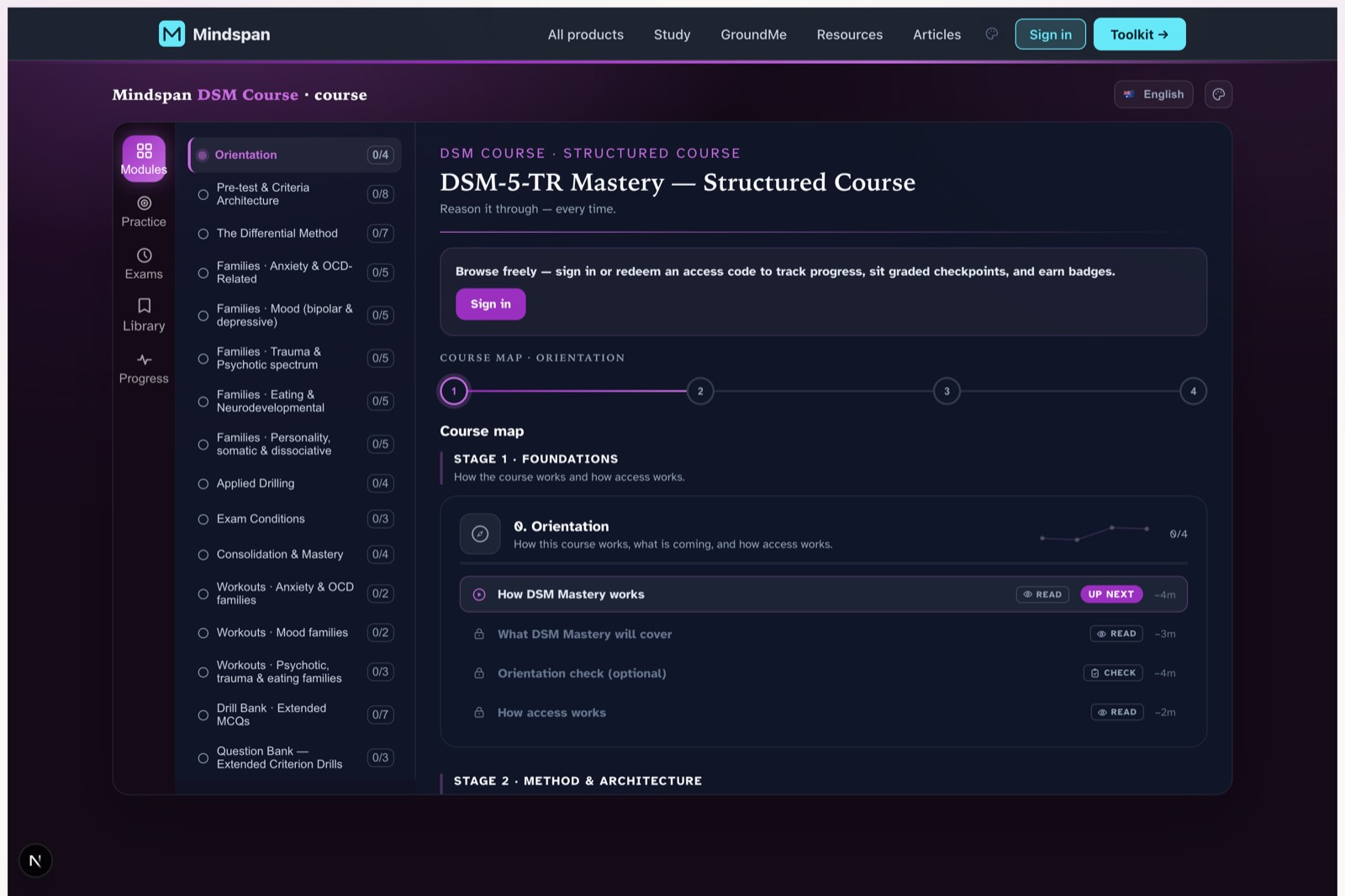
Modules unlock in order, each lesson ends with a short consolidation, and your progress saves as you go — the dashboard shows where you are and resumes where you stopped.
…and 7 more modules.
Walk the real course dashboard and its opening lessons before you pay — no card needed.
Who is this for?
For students preparing for the psychology OSCE in a Master of Professional / Clinical Psychology program, provisional psychologists preparing for the National Psychology Exam, postgraduate psychology students, graduates and clinicians revising differential reasoning.
How is this different from reading the DSM-5-TR itself?
APS members can access the DSM-5-TR text. This module helps you practise applying it: criteria maps, specifiers in context, differential grids and vignette questions.
Is there an Australian-specific focus?
Yes. It covers Australian exam and training contexts, including the psychology OSCE in Master of Professional / Clinical Psychology programs and MPsych placements. Cultural and contextual notes appear where relevant.
What format will the materials be in?
Read HTML pages online and use the interactive question bank. Available materials open when your access begins.
How much does it cost?
A$149 incl. Australian GST. One payment for 12 months access.
Is this affiliated with AHPRA, the APS, or any university?
No. A registered psychologist created this independent study resource. The Psychology Board of Australia is the source for official exam requirements.
What if the price drops after I buy?
If you bought a program in the 30 days before we introduced a bundle or a lower price, ask us and we'll refund the difference or apply it to an upgrade. Ask from My Mindspan (/account/refund) or email info@mindspan.com.au.
Educational use only. This module is an independent educational resource authored by a registered psychologist. It is not affiliated with AHPRA, the Psychology Board of Australia, the APS, or any university. These materials are not official exam guidance and are not a substitute for clinical supervision, mandated training, or professional development requirements. See our Disclaimer, EULA, and Terms of Service.